
Finding Home: A Look at Pets in India
Something has changed in India. Quietly, without much fanfare, the relationship we have with our animals has been completely transformed. It’s a shift you can see on morning walks in city parks and in the living rooms of apartments across the country: pets are no longer just guards or workers; they've become family.
This change is deeply personal, woven into the fabric of modern Indian life. It's a story about our homes, our hearts, and how a wet nose and a wagging tail can change everything.
The Shift in Our Homes
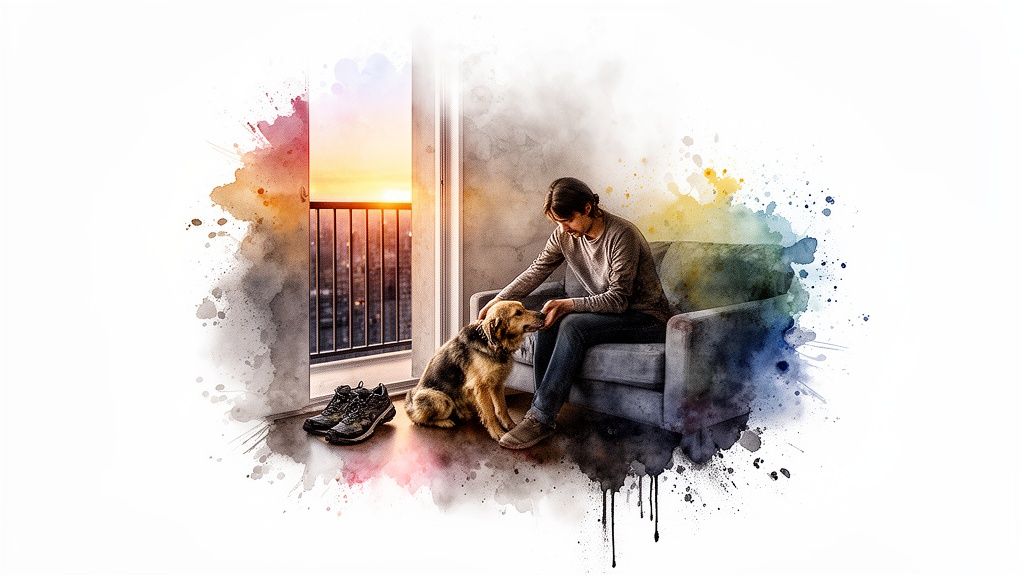
Often, it starts without a grand plan. Think of the neighbourhood street dog you start feeding leftovers to. At first, it's just a casual act of kindness. But soon, that dog becomes a fixture on your veranda, its familiar bark a sound of comfort in the night. Before you know it, it's no longer just a visitor; it’s your dog.
Other times, the journey is more deliberate. A young professional, living alone in a bustling city, decides to bring home a kitten. They're not looking for a pest controller; they're looking for a warm, steady presence to greet them after a long day. This simple decision is a world away from the time when animals were kept purely for a purpose—guarding the house or keeping mice away. Today, their main role is companionship.
From Courtyard to Living Room
This emotional evolution is happening everywhere, from the biggest metros to the smallest towns. The place of pets in our lives has literally moved—from the periphery, like the courtyard or the front gate, straight into the heart of our homes. An animal is no longer just an asset; it's an emotional anchor.
This transformation isn't happening in a vacuum. It’s a reflection of how Indian society itself is changing, creating a space for these new kinds of bonds to flourish.
Smaller Families: As nuclear families become more common, the emotional dynamics inside a home have shifted. A pet often fills a empty space, offering companionship to single people, young couples, or children who don't have a large network of siblings and cousins around.
Changing Lifestyles: Life in the city can be isolating. For the millions who move for work, the unconditional affection of a pet can provide a powerful sense of belonging.
A New Definition of Care: We've expanded what it means to care for an animal. It’s not just about food and a roof over their head anymore. Now, it’s about their emotional well-being, keeping them content, and sharing life's small moments together.
This revolution isn't just about what we do, but how we see them. It's that moment you find yourself talking to your pet as if they understand every word. It's rearranging your schedule for their comfort. It’s the profound, unspoken peace their presence brings to a room.
A Story Told in Numbers
This deeply personal shift has a very public face: the growing pet care market. It has become one of India's fastest-growing industries, which tells you something about this cultural sea change. The Indian pet services market alone was worth USD 485.1 million in 2023 and is projected to reach USD 1,025.0 million by 2030.
This growth is tied to rising incomes and the fact that nuclear families now make up about half of all Indian households. You can look closer at these market trends and how they connect to our changing family structures on Grand View Research.
But the numbers only tell half the story. They can't capture the countless small, unrecorded moments that make up this new reality: a hand reaching down to stroke soft fur, the shared silence of an evening walk, or the pure, unadulterated joy of being greeted at the door. It’s in these loving interactions that you find the true meaning of what it is to have a pet in India today.
The Many Faces of Animal Companionship
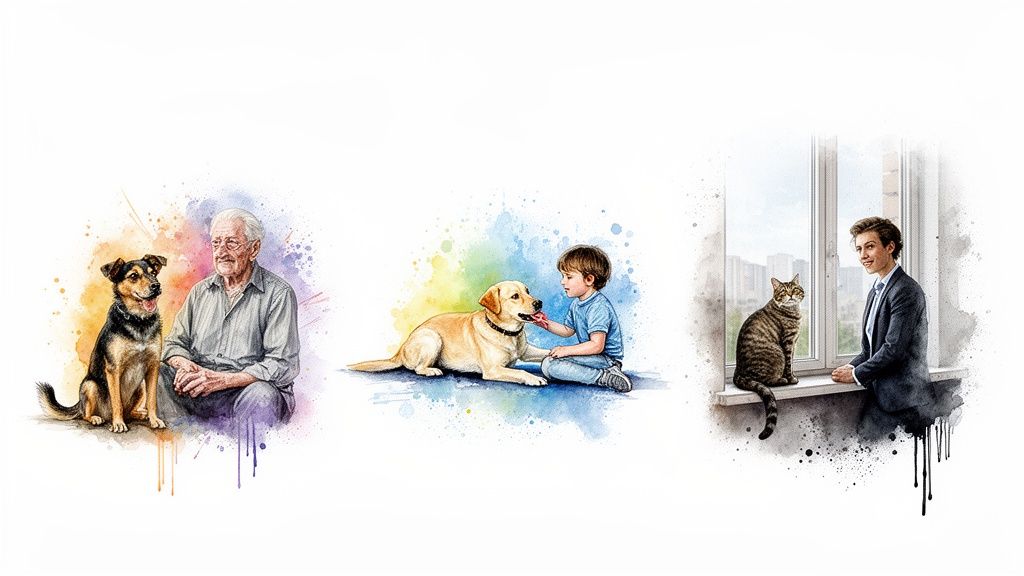
If you were to paint a picture of pets in India, you couldn't just use one canvas. You’d need a sprawling mural, filled with countless different scenes, each telling its own story of connection. And the faces in that mural are growing more numerous and varied with every passing year.
The whole idea of having a pet has shifted. Incredibly, 55% of Indian households now share their home with a companion animal. Dogs are still the most common, found in 63% of these homes, but cats have truly found their footing, now residing in 42% of pet-owning households.
The growth has been astonishing. Back in 2018, there were around 19 million pet dogs in the country. By 2023, that number had soared to over 31 million. That's a huge leap, and it says a lot about how our relationship with animals is changing. For a closer look into these figures, you can explore more pet ownership statistics in India on Dogster.com.
But numbers only tell part of the story. The real truth is in the details of daily life, in the unique bonds that form between people and the animals they love.
A Snapshot of Pet Companionship in Indian Households
This table provides a quick look at the key numbers reflecting the pet culture in India, showing how deeply dogs and cats have become part of the family fabric.
Metric | Statistic |
|---|---|
Households with Pets | 55% |
Pet-Owning Homes with Dogs | 63% |
Pet-Owning Homes with Cats | 42% |
Pet Dog Population (2018) | ~19 Million |
Pet Dog Population (2023) | 31 Million |
These figures clearly illustrate not just the popularity of pets, but a genuine cultural shift towards embracing them as integral members of our households.
The Resilient Indie
The most iconic figure in this mural has to be the Indie dog. For generations, they've been the silent observers of our lanes and bylanes, a constant, watchful presence. They are woven into the very fabric of our neighbourhoods, their ancestry a rich tapestry of pure resilience and adaptation.
For a long time, their place was on the street—cared for by the community but belonging to no one in particular. That’s changing. More and more, these incredibly intelligent, sturdy dogs are being welcomed across the threshold and into our living rooms.
Their journey from the lane to the sofa is a powerful story of acceptance. It's a growing recognition of the fierce loyalty and unconditional love they've always offered. They carry the spirit of India's streets within them—a strength and a deep-rooted sense of belonging.
The Beloved Breeds of the City
Take a walk through any urban park in the early morning, and you’ll see another side of the story. Here, you'll find Labradors and Golden Retrievers chasing tennis balls with boundless enthusiasm, their joyful barks echoing through the morning mist.
These breeds have become almost synonymous with the idea of the modern family pet in many Indian cities. Their gentle temperaments and playful natures fit so well into the lives of families with children, adding a layer of warmth and activity to apartment living.
A Golden Retriever's soft head resting on a lap during a movie night, or a Labrador’s insistent nudge with a toy—these are the small, cherished moments that define their place in the home. They are companions for laughter, for weekend trips, and for the simple comfort of a predictable, loving presence. You can browse our collection of thoughtful items that celebrate these small moments of connection in the Soulknit shop.
The Reign of the Feline
In the quieter corners of our mural, you'll find the cats. Their world is often more contained, their companionship more subtle. In a small flat, a cat can turn a simple windowsill into a kingdom, its silent observation a calming counterpoint to the city’s constant hum.
For someone living alone, a cat's presence can be a profound comfort. It's the soft purr that greets them at the door, the gentle weight on the bed at night. Unlike the boisterous energy of a dog, a cat offers a more introspective kind of connection.
Their relationship with their human is a dance of understanding, built on routine, mutual respect, and the shared peace of a evening at home.
Each of these faces—the Indie, the Labrador, the apartment cat—represents a different kind of bond. Together, they create a rich and evolving picture of what it means to share a life with an animal in India today.
Stories from City Balconies and Country Courtyards
The story of a pet’s life in India is written by the place they call home. It’s a tale told in two completely different dialects—the clipped, hurried language of the city and the slow, sprawling poetry of the countryside. This geography shapes everything, from their daily routines to the very texture of the bond they share with their people.
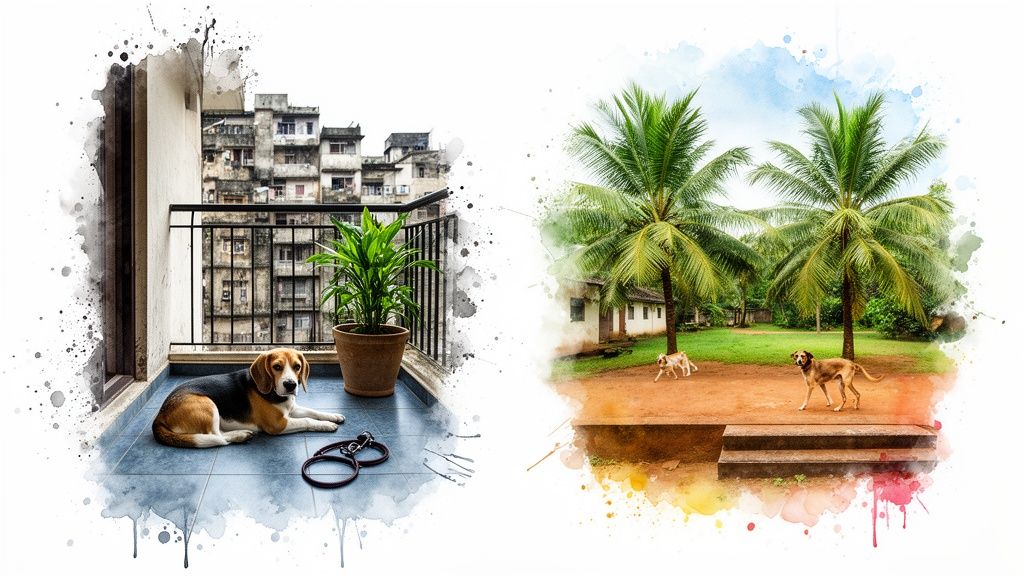
Picture a little beagle named Murphy, living in a second-floor flat in Mumbai. His world is a sensory map of contained spaces. It’s the cool, smooth feel of the tiled floor on his belly during a humid afternoon, a welcome escape from the city’s relentless heat. His days are marked by a familiar, comforting rhythm.
The jangle of his leash is the first sound of adventure, a promise of the world outside. This world is a concrete pathway leading to a small, gated park where the grass is a precious commodity. For a brief, glorious hour, he is a dog untethered, his nose twitching, cataloguing the scent of a hundred other lives that have passed through this same patch of green.
Back in the flat, his kingdom is the balcony. From this perch, he observes the city’s theatre—the distant drone of traffic, the sharp cry of a vegetable vendor, the flutter of pigeons on a neighbouring ledge. These sounds are the wallpaper of his life. His companionship is an intimate one, an anchor in the vertical world of apartment living.
Life in the Open Air
Now, let's shift the scene hundreds of kilometres south, to a family home nestled in a village in Kerala. Here, a cheerful Indie dog named Rani wakes not to an alarm clock, but to the chorus of birds in the sprawling mango tree shading the courtyard. Her world isn't defined by walls, but by the gentle curve of the earth and the scent of damp soil after a night of rain.
Rani’s life is one of fluid boundaries. The courtyard is her domain, a sprawling, open-air living room where she naps in patches of sun and chases squirrels with a playful, half-hearted enthusiasm. She isn’t just one family’s pet; she is a known character in the lane, a familiar, wagging presence greeted by neighbours on their morning walks.
Her days aren't dictated by a precise schedule, but by the natural rhythms of the household and the world around her.
The Sounds of Silence: Her soundscape is one of quiet, punctuated only by rustling palm fronds, the distant lowing of a cow, and the familiar voices of her family calling her name.
A Wider Circle: Her community extends far beyond her immediate family. She’s part of a larger, interconnected web of life, her presence woven into the daily fabric of the village.
Freedom and Flow: Her movements are freer, her world wider. The bond here is less about contained intimacy and more about a shared existence, a life lived in parallel with the humans and nature around her.
The contrast isn't one of quality, but of experience. Murphy’s life is a story of focused, distilled companionship, a deep bond forged in close quarters. Rani’s is a story of expansive belonging, a connection that breathes with the open space around it.
These narratives, echoed in countless homes across the country, show how pets in India live lives that are profoundly shaped by their environment. Each setting, with its unique sensory details and social structures, creates a different kind of companionship. It is in these lived experiences that we find the heart of the human-animal bond—a connection that adapts and deepens, whether on a bustling city balcony or in a country courtyard. You can explore more of these heartfelt connections in Soulknit Short Stories About Pets and Their People, a collection that honours these moments.
The Unspoken Contract of Care
When you bring a pet home, you're making a silent promise. There are no papers to sign or terms to discuss, but a profound agreement is made all the same. It’s an unspoken understanding that their life is now tied to yours. This isn't about grand, cinematic moments; it’s a commitment built on the small, repeated rituals of daily life.
Think about it. It’s the familiar heft of a bag of dog food, the rhythmic scoop into a bowl that’s always in its spot. It's the soft, rumbling purr that begins the second you start stroking a brush through a cat’s fur. These are the seemingly mundane, almost automatic acts of care that, day by day, become the very bedrock of your bond.
This relationship truly comes alive in the moments. The shared stillness of an early morning, watching the world wake up together. The comforting weight of a warm body curled up at your feet after a long, draining day. These little routines become emotional anchors for us, steadying points in the chaos of our own lives. They are proof that we are needed, that our simple, consistent actions mean the world to another being.
A Deeper Sense of Responsibility
This daily rhythm of care has a way of changing you. What starts out as a list of tasks—feeding, walking, cleaning—slowly, almost without you noticing, transforms into a deep-seated sense of responsibility. This isn't a heavy burden; it’s a natural extension of the affection that has grown between you. It's that dawning realisation that you are their entire world. Their source of comfort, their safety net, their joy-bringer.
This growing personal responsibility mirrors a much larger cultural shift happening across India. We're seeing a rising awareness of what it truly means to care for an animal. The conversation around animal welfare is moving beyond just providing food and shelter and into a more thoughtful understanding of their emotional and physical needs.
A Shift in Perspective: We're learning to see the world from their eyes. We're understanding that a frightened dog needs patience, not punishment, and a shy cat needs a safe space, not forced cuddles.
The Importance of Health: That annual trip to the vet, once considered a luxury by many, is now becoming a non-negotiable part of the relationship. It’s a clear sign that we're taking their well-being seriously.
Emotional Well-being: We’re starting to truly acknowledge their inner lives—their ability to feel joy, fear, and even grief. This understanding changes our role from owner to that of a guardian and a friend.
This shift isn't being driven by new laws, but by a collective opening of the heart. It’s simply what happens when we invite these creatures so completely into our lives.
When we commit to caring for an animal, we are also committing to our own growth. We learn patience when they test our limits. We learn empathy as we try to decipher their silent language. And we learn the, steady strength of unconditional love.
From Pet to Family Member
Then, one day, it happens. There's a moment when the contract is sealed, when the animal officially crosses that invisible line from "pet" to "family." It’s a quiet, unannounced promotion. It might be the first time you rearrange your holiday plans just for them, or the moment you catch yourself telling a stranger a story about them with the same beaming pride you would for a child.
It’s the sudden realisation that your home would feel impossibly empty without the click-clack of their nails on the floor or their soft breathing from the next room. They become woven into the very fabric of your life, their presence a constant, comforting thread. And that’s when you understand the unspoken contract is a circle: in looking after them, we find a part of ourselves is being looked after in return.
The Hands That Heal and Help Our Animals
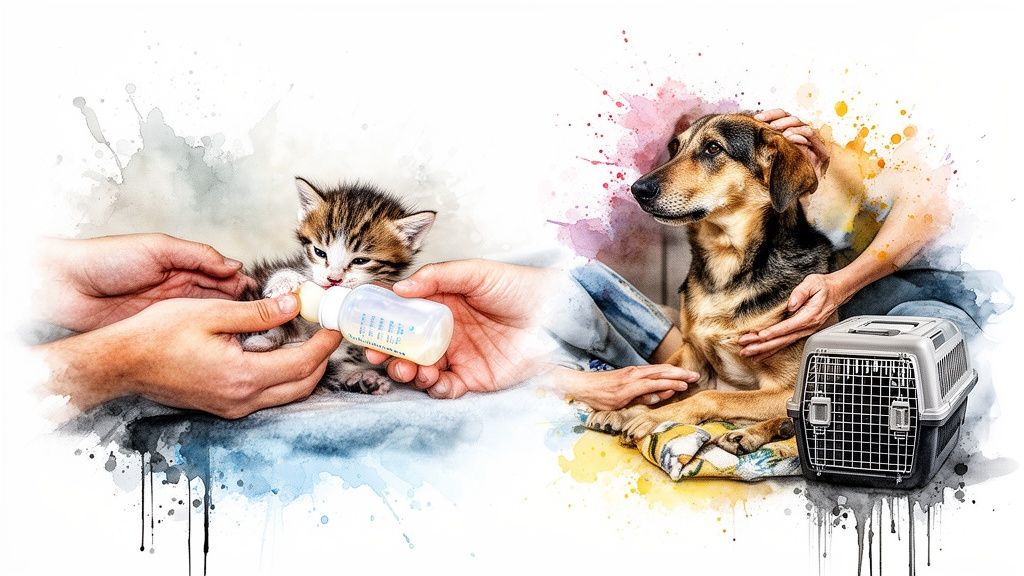
Out on the streets, beyond the comfort of our homes, another kind of family is hard at work. It's a vast, informal network built on compassion—a community of people united not by blood, but by a shared mission to help the animals who have no one. This is the heart of animal rescue and welfare in India, powered by ordinary people doing extraordinary things every day.
You won't find the real story in annual reports or spreadsheets. It lives in the small, often unseen acts of kindness that play out on our streets. It’s in the patient hands of a volunteer at a local shelter, coaxing a terrified Indie dog out of its shell with soft words until that first flicker of trust appears.
It’s the software engineer who dedicates her weekends to driving to construction sites, leaving bowls of food and fresh water for the resident community dogs. She knows them all by name and temperament, even where the shy new mother has hidden her pups. Her work isn't for recognition; it's a silent promise, a steady, reliable presence in their often uncertain lives.
The Dedication of a Foster Home
Step into the world of a foster parent, and you’ll see this dedication up close. Their home becomes a temporary sanctuary, a vital halfway house between a life of hardship on the streets and the hope of a loving family. It’s where a litter of abandoned kittens, barely a week old, first learns the warmth of a gentle hand and the simple comfort of a full belly.
This work is a relentless cycle of care. It’s the two-hourly feedings with a tiny syringe through the night. It’s the gentle cleaning of fragile little bodies and the, personal victory when the weakest kitten finally starts to gain weight. There are no awards or public praise—just the deep satisfaction of shepherding a life back from the brink.
Fostering demands a specific kind of strength. You need a heart big enough to love an animal completely, knowing you'll have to let it go. Each goodbye is a little heartbreak, but it's also a bittersweet success story, measured in the trust you’ve rebuilt in a once-frightened soul.
A Network of Compassion
This community is a mosaic of different people, each contributing in their own way. They are the ones who simply can't look away when they see an injured bird on the roadside or a dog limping through traffic. Their collective compassion fuels a network that runs on empathy and grit.
The First Responders: These are the people whose numbers are passed around neighbourhood WhatsApp groups. They're the ones who will drop everything to rush an injured animal to the vet.
The Silent Donors: They are the consistent supporters who contribute what they can—a bag of rice, a small monthly donation—just to help a local shelter keep its doors open for one more month.
The Advocates and Educators: These are the voices for the voiceless, working to raise awareness about animal cruelty and promote kindness through adoption drives and community outreach.
It’s in these countless, unheralded acts of service that we see the true spirit of animal welfare in India. This isn't a movement driven by grand gestures, but by the relentless, cumulative impact of individual compassion.
This work isn't just about saving animals; it's about mending a broken piece of our shared world. It’s empathy in action. The hands that mix medicines, sterilise surgical tools, or simply offer a comforting stroke to a scared animal are the very same hands building a more humane community for us all. They are a vital chapter in the evolving story of pets in India, reminding us that the circle of care extends far beyond our own front doors. Their dedication is a powerful testament to the belief that every life is worthy of kindness.
A Gentle Reflection on the Companionship We Keep
After all the stories from city balconies and country courtyards, after looking at the unspoken promises we make and the hands that heal, we come back to where we started. We land on the simple truth of why we share our lives with animals in the first place.
It’s a truth you won’t find in grand gestures, but in the small, sacred spaces they carve out just for us. It’s the steady, comforting weight of a warm body beside you on a day the world feels too heavy to carry alone. It’s the sheer, unfiltered joy in a wagging tail that greets you at the door—a welcome that never seems to get old.
These relationships become our teachers. They teach us about a love that doesn't demand anything in return and show us the profound ache of loss when their time with us is up. In their short, brilliant lives, they offer a powerful, condensed lesson in what it means to care for another being completely.
Finding Ourselves in Their Care
There’s a gentle magic that happens when you care for a pet. In the steady rhythm of filling a food bowl or the patient act of brushing a tangle from soft fur, we often find a stronger connection to ourselves. Their needs pull us out of our own heads, grounding us firmly in the here and now.
Their simple existence is a constant reminder of what really matters. A dog doesn't care about our deadlines, and a cat isn't fussed about our ambitions. They only know the kindness in our hands and the softness in our voice. In a way, they anchor us to a more fundamental way of being.
We think we are the ones offering them a home, but so often, they are the ones who make a place feel like one. They are the keepers of our moments, the silent witnesses to our lives, holding space for our joys and our sorrows without judgement.
A Lasting Echo
The mark they leave on us is permanent. It’s in the phantom feeling of fur against your leg long after they’re gone, or the muscle memory of reaching down to scratch an ear that is no longer there. Their presence becomes a part of our own story, woven so deeply into the fabric of our days that it remains even in their absence.
This journey we take with our pets in India is really a reflection of a deeper human need for connection—one that goes beyond language and culture. It’s a testament to our capacity for empathy and our search for a love that is simple, true, and unconditional.
As we continue to explore these bonds, we find that the stories are endless, each one a unique thread in a larger, beautiful tapestry. For more heartfelt narratives and gentle reflections on the connections we share, you can visit us at Soulknit, a place dedicated to honouring these moments.
In the end, maybe the greatest gift they give us is the chance to see ourselves through their eyes: as a source of comfort, a provider of care, and the centre of their small, precious world. And that’s a reflection that always reminds us of the best parts of who we are.

Comments